

GEMOLOGY
Why unheated Ceylon sapphire color reads differently on screen
A buyer in Hong Kong approves a stone from a WhatsApp photo. It arrives in daylight and looks grey-blue instead of cornflower. The deal falls apart. The stone didn't change. The light did.
Unheated Ceylon sapphires are especially sensitive to this. No heat means natural color zoning, silk, and subtle undertones that shift with angle and source. Capture and display have to account for that, or you're selling a color that doesn't exist in the box.
Three lights, three stories
Dealers judge stones under mixed conditions. Each source tells a different story about the same crystal:
- Studio daylight (~5600K): What I shoot under. This is not the same as the 6500K D65 reference printed on monitor specs or gem reports - that is a color-science anchor, not a practical light for photography. 5600K daylight-balanced LED is the sweet spot on camera: cool enough to show true blue body color and zoning in unheated Ceylon stones, without the icy grey cast D65 panels often push onto corundum.
- Office LED (typically 3000-4500K): Common in Ratnapura and Colombo offices. Warmer than capture daylight. Can flatter a stone by hiding grey windows, or make silk and color zoning harder to read.
- Phone screen: Displays target D65 (~6500K) in theory, but add compression, sharpening, auto-exposure, and auto white balance. Blues punch harder; subtle violet or green undertones flatten. A padparadscha peach can disappear entirely.
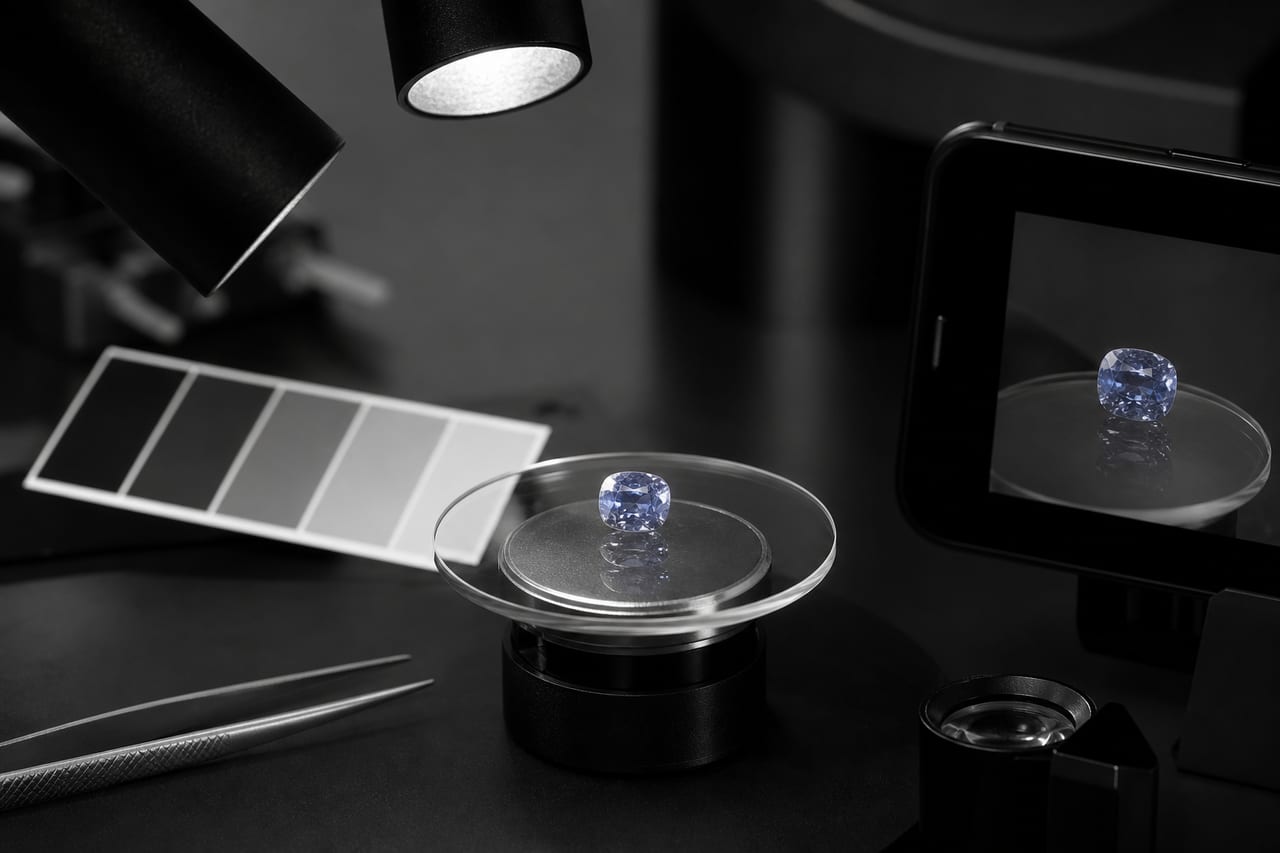
A single still under office LED is not enough for an overseas buyer. Video under controlled 5600K daylight, with a slow turntable rotation and locked exposure, shows how color actually travels across the table - not how it looked under one warm bulb or one flattering angle.
6500K vs 5600K - why it matters
D65 at 6500K is the standard for sRGB screens, many lab color references, and export paperwork. Dealers hear "daylight" and assume that is what the video used. It usually is not.
In practice, 5600K matches what photographers have called daylight-balanced for decades - close to midday sun through cloud, closer to how a stone reads in a neutral window than a cold D65 panel does on sensor. On unheated sapphires, the difference is visible: 6500K can drain warmth from the crown and leave a stone looking grey-blue on film when it reads lively blue-violet in hand. 5600K keeps the trade-off honest.
What turntable video fixes
Rotation reveals color shift buyers care about: blue to violet at the girdle, grey window at one pole, silk flash at another. A still from the "best" angle hides the rest. Ten seconds of video shows the full behavior.
For unheated stones, honesty sells better than a flattering single frame. Buyers who see the zoning upfront trust the listing. Buyers who get a surprise on arrival don't come back.
Practical capture notes
- Shoot under ~5600K daylight-balanced LED or strobe with the same kelvin on every stone in a session - not warm office bulbs, and not uncalibrated "6500K" panels unless you have verified them on camera.
- Lock white balance and exposure for the full rotation. Auto-exposure and auto-WB on phone video are the main reasons colors lie.
- Keep fill soft and even. Hard side light flatters one facet and hides windows on the next pass.
- Deliver WebM/MP4 under 5 MB so mobile buyers actually watch the full rotation.
- Pair video with a neutral still for catalogs, but lead with video for color-critical unheated stones.
Need capture that shows unheated Ceylon color accurately? Get in touch.