



DIGITAL SOLUTIONS
From stone to shop: what an automated gem ingest pipeline handles
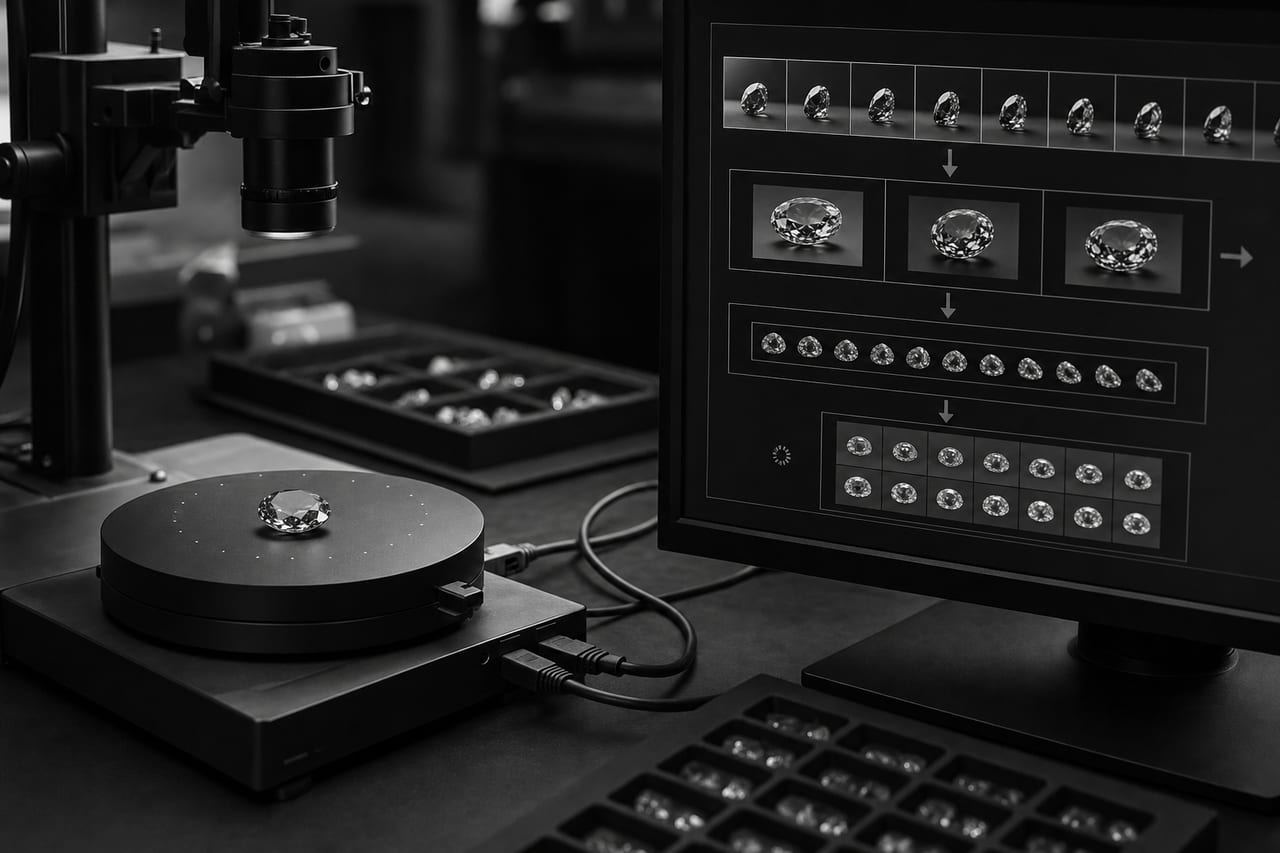
Most dealers still run inventory like it's 2012: shoot a clip on phone, save stills to a folder, type specs into Excel, paste again into WhatsApp, then hope someone updates the website before the stone sells.
The pipeline I build for clients removes those handoffs. The stone goes on the turntable once. Everything after that - security, processing, the live shop listing, and day-to-day catalog management - runs through one automated workflow your team can learn to operate.
This isn't a tutorial on our internal tooling. It's the shape of the system: what happens between capture and a buyer seeing your stone online, and what keeps working after launch.
1. Intake: one controlled capture session
The pipeline starts when the stone is on the turntable under consistent light. One rotation produces the video, stills, and spin frames your catalog needs - not a separate phone session for WhatsApp and another for the website.
At intake, basic metadata travels with the capture: carat, dimensions, treatment notes, origin, internal SKU. That data is attached once and follows the stone through every downstream step. No re-typing at the export desk.
2. Security: assets protected before they go anywhere
High-resolution captures are valuable. They're also easy to lose - wrong folder, deleted phone clip, staff turnover, a laptop left on a bench in Ratnapura.
Before anything publishes, the pipeline stores originals and working copies in a controlled structure: versioned backups, access limited to your team, and no raw files sitting in public cloud links. If a stone sells or a listing needs to come down, you can act on it without hunting through three people's phones.
The details of how we lock that down stay in-house. What matters to you is that your inventory media isn't scattered, and you're not one deleted folder away from re-shooting a $12,000 sapphire.
3. Handling: automated processing and quality checks
Raw capture files are too large for a fast mobile catalog. The ingest stage handles compression, format conversion, and derivative generation - web video, catalog stills, 360° frames - from the same source rotation.
Automated checks catch common failures before a listing goes live: mismatched filenames, missing metadata, a stone marked available when it's already sold, a thumbnail that doesn't match the video stem. Human review still happens where it should - pricing, treatment disclosure, final copy - but the repetitive file work doesn't fall on your office staff.
4. Online shop: from processed assets to live listing
When processing completes, the catalog updates: video on the stone page, stills for social and inquiry threads, specs pulled from the same record as the media. Inquiry forms route to your WhatsApp or email. Sold stones can be flagged without rebuilding the whole site.
The shop reads from one inventory source. You're not maintaining a website catalog, an Excel sheet, and a PDF export that all disagree about what's in stock.
5. Continuous support: the catalog stays current
Launch isn't the end. Stones sell. Prices change. New stock arrives weekly. A pipeline worth paying for handles ongoing updates - new ingest sessions feeding new listings, status changes propagating everywhere the stone appears, and a clear audit trail of what changed and when.
That continuity is what separates a proper digital catalog from a one-time website build that goes stale in three months.
6. In-house training: your team runs the workflow
The goal isn't dependency on one outside operator forever. After setup, your staff learn the intake routine: how to place a stone for capture, what metadata to confirm, how to trigger an ingest, and how to verify a listing before it goes public.
Training covers the management layer too - marking sold, updating pricing flags, pulling stills for a buyer in Bangkok, knowing when to escalate to a re-shoot. The system is designed so a trained office manager in Colombo can keep the catalog honest without calling me for every single stone.
I stay available for pipeline upgrades, new features, and the stones that need a custom treatment. Day-to-day inventory flow should live with your team.
What this replaces
Without a pipeline, every stone costs you time four times over: capture, file management, listing entry, and follow-up when something sells. With one, the turntable session is the only manual creative step. Security, handling, publishing, and ongoing management connect automatically.
That's the offer: not just pretty video, but a system that keeps your online shop as current as your showcase in hand.
Want a stone-to-shop pipeline scoped to your inventory? Get in touch.